
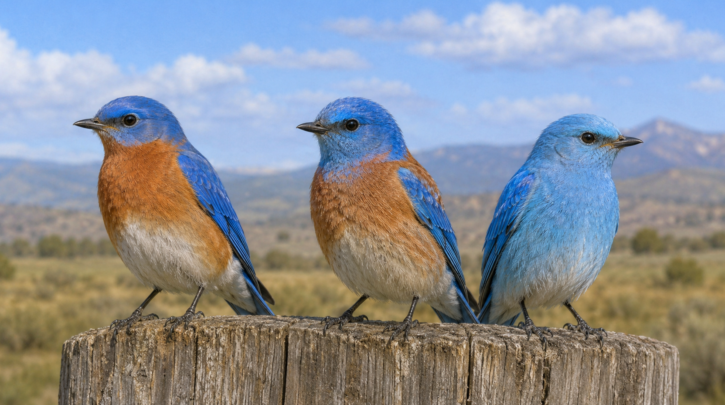

“Bluebird” isn’t one species — it’s three. North America is home to the Eastern Bluebird (Sialia sialis), Western Bluebird (Sialia mexicana), and Mountain Bluebird (Sialia currucoides), and while all three belong to the thrush family alongside American Robins, they’re distinct enough in color and range that identification usually comes down to two questions: where are you standing, and how much orange do you see?
This site participates in affiliate programs. If you buy through a link on this page, we may earn a commission at no extra cost to you. Affiliate disclosure
The Fast Answer: Range First
Range narrows the field before you even raise your binoculars. Eastern Bluebirds occupy everything east of the Rocky Mountains, from southern Canada down into Mexico and year-round through the Gulf states. Western Bluebirds stick to the Pacific coast, the Southwest, and interior mountain woodlands. Mountain Bluebirds favor open, high-elevation country — sagebrush flats, alpine meadows, and prairie — from Alaska down through the Rockies into the desert Southwest in winter. Overlap zones exist, especially in parts of the interior West, which is where plumage details start to matter.
Eastern Bluebird
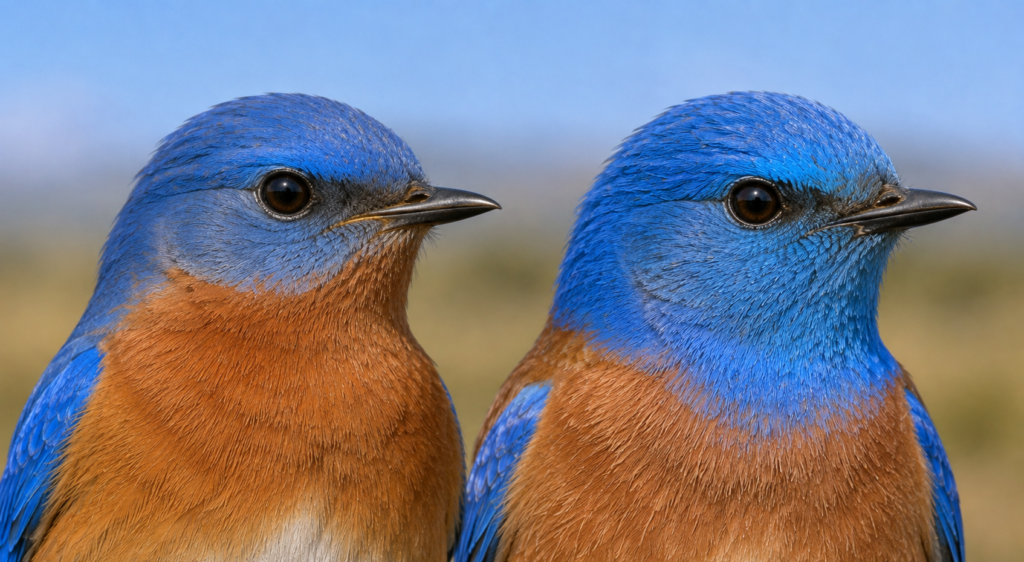
- Male: deep blue head, back, and wings; rusty-orange throat, breast, and flanks; white belly
- Female: grayish head and back with a blue wash on wings and tail; muted orange breast
- Habitat: open country with scattered trees — farmland, orchards, golf courses, roadside edges
- Range: entire eastern half of the continent, resident year-round in the South
Western Bluebird
- Male: blue head extending down the throat (no orange throat patch, unlike Eastern), rusty breast and a distinctive rusty patch on the upper back
- Female: duller gray-blue overall, with a faint rusty wash on the breast
- Habitat: open woodlands, oak savanna, and burned or logged forest with standing dead trees
- Range: Pacific states, the Southwest, and interior mountain West
Eastern vs. Western: The Throat Test
If you only remember one field mark, make it this: an Eastern Bluebird’s throat is orange. A Western Bluebird’s throat is blue, with the orange confined to the breast and that telltale rusty patch on the back. In the narrow zones where their ranges meet, that throat color is the fastest, most reliable way to separate the two.
Mountain Bluebird
- Male: entirely sky-blue, brightest on the wings and tail, with no rusty orange anywhere on the body
- Female: soft gray-brown overall with a pale blue wash on wings and tail; often confused with a female Eastern or Western at a distance, but note the total absence of any orange tone
- Habitat: open, treeless or sparsely treed terrain — unlike the other two species, Mountain Bluebirds are comfortable well away from woodland edges
- Range: the most northerly and high-elevation of the three, breeding as far north as Alaska
Juveniles: The Great Equalizer
All three species hatch out looking almost nothing like their parents. Juvenile bluebirds of every species are heavily spotted on the breast and back, gray-brown overall, with only a hint of blue showing on the wings and tail. This spotted plumage is a classic thrush-family trait shared with young robins, and it molts out within a few months as the first blue feathers come in.
Quick Reference Table
- Orange throat + orange breast = Eastern Bluebird
- Blue throat + orange breast + rusty back patch = Western Bluebird
- No orange anywhere, all blue (male) or plain gray-brown (female) = Mountain Bluebird
The single fastest field mark across all three species is the throat: orange means Eastern, blue means Western, and the total absence of orange means Mountain.
What to Do Once You’ve Made an ID
Identified a pair checking out a nest cavity on your property? That’s the moment to think about a nest box. See our nest box guide for hole sizes and placement that work for all three species, and our guide to telling males from females if you want to track a specific breeding pair through the season.
Not sure which species is visiting your yard? Our binoculars buying guide covers the optics that make throat-color and back-patch details easy to see from typical backyard distances.
Overlap Zones and Range Confusion
The interior West is the one place where identification gets genuinely tricky, because Western and Mountain Bluebird ranges overlap broadly across much of the intermountain region, and Eastern Bluebirds push far enough west on the Great Plains to occasionally meet Western Bluebird territory as well. In these overlap zones, don’t rely on a single field mark. Cross-check throat color, the presence or absence of a rusty back patch, and overall habitat — Mountain Bluebirds favor genuinely open, sparsely treed ground in a way the other two species rarely do.
Seasonal Movement Complicates Range Maps
Range maps show general patterns, not fixed borders. Eastern Bluebirds in the northern part of their range migrate south for winter, temporarily overlapping with resident southern populations. Mountain Bluebirds are the most migratory of the three, breeding as far north as Alaska and wintering as far south as northern Mexico, which means a Mountain Bluebird sighting in a place like Arizona could represent either a wintering bird or a rare local breeder depending on the season. Always check a current range map for the specific time of year rather than assuming a static boundary.
Size and Shape as Secondary Clues
All three species are similar in size — roughly 6.5 to 8 inches long with a wingspan around 12 to 14 inches — so body size alone won’t separate them. Silhouette can still help rule out look-alikes, though. Bluebirds perch upright with a fairly large, rounded head and a short, straight bill built for catching insects rather than cracking seed, which distinguishes them at a glance from finches or sparrows showing a similar blue-gray tone in poor light.
Confirming an ID at the Nest Box
If a pair is investigating a nest box on your property, watching behavior for even a minute or two usually confirms the species faster than plumage alone, simply because you get a clear, close, repeated look. Note which bird enters the cavity (almost always the female), how long she stays inside, and whether the male perches nearby delivering food — details covered in more depth in our guide to telling males from females.
A camera nest box like the Birdfy Nest Duo gives you that clear, repeated look automatically, with one camera on the entrance and one inside the box.