
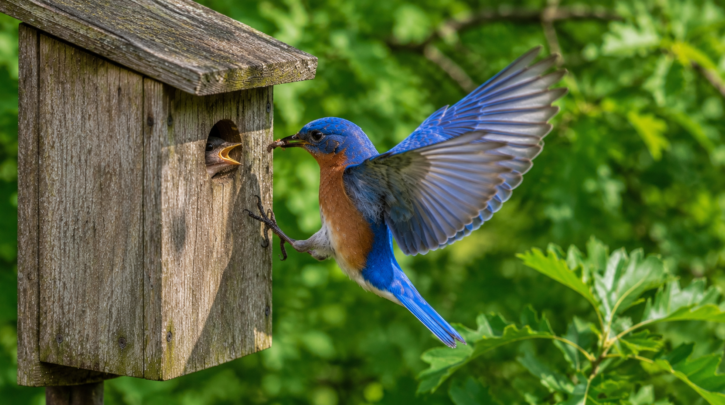

Summer is when the season’s workload peaks. Between raising a first brood, often starting a second, and doing it all while insect activity and heat are both at their highest, adult bluebirds are busier in summer than at any other point in the year.
This site participates in affiliate programs. If you buy through a link on this page, we may earn a commission at no extra cost to you. Affiliate disclosure
First Brood: Hatching Through Fledging
Eggs laid in late spring hatch roughly 12 to 14 days later, and chicks then take another 17 to 21 days to fledge — meaning a first brood often reaches independence right around early summer. See our full baby bluebirds guide for what happens at each stage of that timeline.
Peak Insect Feeding
Summer coincides with peak insect abundance, which is no accident — growing chicks need concentrated protein, and parents time nesting to match the season when caterpillars, beetles, and grasshoppers are most available. This is also when supplemental mealworm feeding has the biggest impact, since it reduces the distance and effort parents spend covering ground to find enough food for a hungry brood. See our mealworm guide for feeding specifics during this demanding stretch.
Heat Management
Summer heat is a genuine risk inside a poorly ventilated nest box, particularly for boxes facing full afternoon sun. Well-ventilated, light-colored wooden boxes handle summer heat far better than dark-painted or metal alternatives — see our nest box guide for the ventilation and material details that matter most in hot weather.
Watching for Heat Stress
Nestlings panting with their beaks open, or parents making unusually frequent trips without obvious food deliveries, can be early signs a box is running too hot. Shade from a tree or structure, without blocking the flight path to the entrance, can help moderate box temperature in particularly exposed locations.
Starting a Second Brood
Once the first brood fledges and becomes reasonably independent, many pairs begin a second nesting attempt, sometimes in the same box after a quick cleanout, sometimes in a second nearby cavity. It’s common for the male to take over more of the feeding duties for recently fledged young from the first brood while the female focuses on building the new nest.
Fledgling Season
Summer is also when you’re most likely to spot a young, heavily spotted bluebird out of the nest for the first time — a normal stage, not a sign of trouble, as covered in our fledging guide.
Predator Vigilance
Fledglings spending time on or near the ground during this stage are especially vulnerable to outdoor cats. See our predator guide for the full list of summer threats and how nest box design addresses most of them.
Managing two broods in one summer takes a well-maintained box — revisit our nest box guide for cleanout tips between broods.
Late Summer Wind-Down
By late summer, singing and territorial activity noticeably decline as the breeding season winds toward its close, and the loose, non-territorial flocking behavior that dominates fall and winter begins to take over from the pair-focused dynamic that defined spring and summer.
Water Needs Peak in Summer
Hot summer weather makes a reliable water source more important than at any other point in the year, both for adult birds and for parents who need to stay hydrated while making frequent feeding trips in the heat. A shallow birdbath kept topped off and clean is a simple addition that supports bluebirds through the hottest stretches of the season, particularly during dry spells when natural water sources can become scarce.
Managing a Two-Brood Household
It’s not unusual, during the overlap between a fledged first brood and a newly started second nest, to have recently fledged young still being fed nearby while eggs are incubating in the same or a neighboring box. This overlapping schedule is a normal part of how bluebirds maximize reproductive output within a single breeding season, and it’s one of the more interesting things to watch for on a well-monitored property with more than one active box. Keeping notes on which box is doing what during this overlap period makes it much easier to track two broods at once without losing track of either one’s progress.
For a water source that stays inviting in the heat, the Birdfy Bath Pro keeps water moving with a solar-powered fountain and records every visit.
Vegetation Growth and Hunting Efficiency
Fast summer plant growth can quietly work against bluebirds if grass and ground vegetation are left to grow tall and dense, since it makes ground-dwelling insect prey harder to spot from a perch. Keeping open hunting ground mowed or otherwise maintained through summer helps preserve the short-grass conditions bluebirds rely on for efficient foraging during the season’s busiest feeding stretch, and it’s a low-effort habitat maintenance task that pays off throughout the rest of the nesting season.