
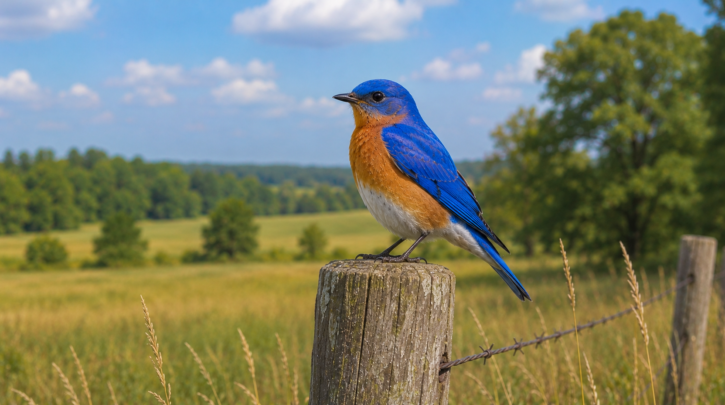

Bluebirds don’t live especially long by bird standards, and most of the risk is front-loaded into the first year of life. Understanding the real numbers — rather than the oldest recorded outlier — gives a much more useful picture of what a bluebird’s life actually looks like.
This site participates in affiliate programs. If you buy through a link on this page, we may earn a commission at no extra cost to you. Affiliate disclosure
Average Lifespan
Most wild bluebirds that survive their first year live somewhere in the range of six to ten years, though the average across a whole population, including first-year mortality, is considerably lower — typically cited around two to three years. The gap between those two numbers is almost entirely explained by how dangerous the first twelve months are.
The First Year Is the Hard Part
Studies of banded bluebirds consistently show that roughly half of all fledglings do not survive to their first birthday. Predation, starvation during cold snaps, and inexperience finding food and shelter all take a toll before a young bird has learned the ropes. Birds that make it through that first year, and especially through their first winter, have odds much closer to the six-to-ten-year range for every year after.
Record Lifespans
Banding records give a sense of the outer limit. The oldest recorded wild Eastern Bluebird lived past ten years of age, confirmed by a band recovery years after it was first tagged as a nestling. These records are the exception, not the rule, but they show the biological ceiling is well above the population average.
What Shortens a Bluebird’s Life
- Predation at the nest — snakes, raccoons, and House Wrens destroying eggs or nestlings
- Nest-site competition — House Sparrows are known to kill adult bluebirds inside a nest box
- Severe winter weather, especially ice storms that cut off access to fruit and insect prey
- Window strikes and vehicle collisions near roadside habitat
- Pesticide use that reduces the insect prey base
What Increases Survival
- A predator-guarded nest box with the correct hole diameter for the species
- A monitored nest-box trail where failed nests are noted and problem boxes adjusted or removed
- Access to native fruiting shrubs for winter food when insects are scarce
- Reduced pesticide use in yards and surrounding fields
Why This Matters for Nest-Box Landlords
Because so much bluebird mortality happens at the egg and nestling stage, a well-designed and well-placed nest box has an outsized effect on lifetime survival for a local population — arguably more than any other single intervention a backyard birder can make. See our nest box guide for the specifics that give a brood the best chance of fledging.
Want to actively improve survival odds on your property? Start with a properly sized, predator-resistant nest box and a monitoring routine.
If you want to follow that routine without opening the box, the Birdfy Nest Duo includes one camera inside the box and one outside the entrance.
How Banding Studies Produce These Numbers
Most of what’s known about bluebird lifespan comes from long-running bird-banding programs, where researchers and trained volunteers fit young or adult bluebirds with a uniquely numbered leg band and record recoveries or re-sightings over time. Because nest-box trails make bluebirds unusually easy to recapture and monitor compared to birds that nest in hard-to-reach natural cavities, bluebirds are among the better-studied songbirds for lifespan and survival data in North America.
Why Averages Can Be Misleading
A quoted “average lifespan” of two to three years sounds discouragingly short, but it reflects a population-wide average that includes the roughly fifty percent of fledglings that don’t survive their first year. For an individual bird that clears that first-year hurdle, the realistic expectation shifts substantially upward, closer to the six-to-ten-year range cited for adults. This pattern — high early mortality followed by much better odds for survivors — is common across small songbirds generally, not unique to bluebirds.
Site Fidelity and Repeat Nesting
Bluebirds that survive their first winter often show strong fidelity to a successful nesting location, sometimes returning to the same box or the same general area in consecutive years. This is part of why long-running, well-maintained nest-box trails tend to see improving fledge rates over time: experienced, returning adults that already know a location’s food sources and predator risks generally out-perform first-time breeders nesting in unfamiliar territory.
The Bigger Picture: Population Trends
Individual lifespan is only part of the story. Eastern Bluebird populations declined sharply through the early-to-mid 20th century due to competition from introduced House Sparrows and European Starlings for nest cavities, before recovering substantially thanks to the organized nest-box trail movement that began in earnest in the 1960s and continues today. That recovery is a reminder that individual-level survival numbers and population-level trends, while related, aren’t the same thing — and that human intervention through nest boxes has measurably moved the population needle.