
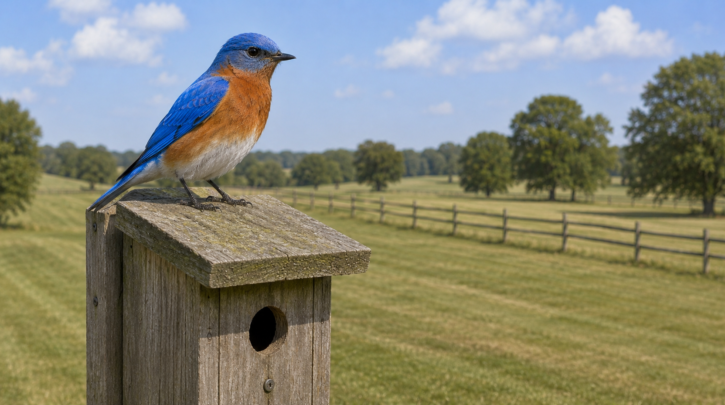

Attracting bluebirds is less about any single product and more about assembling the right combination of open habitat, a nesting cavity, food, and water — the same basic needs that shape where bluebirds naturally choose to live.
Start With Habitat
Bluebirds favor open country with short ground vegetation and scattered perches — think farmland edges, large mowed lawns, orchards, or golf-course-style landscaping rather than dense woodland. If your property is heavily wooded with little open ground, bluebirds are far less likely to visit regardless of what food or boxes you provide. A yard with at least a modest patch of open lawn or field, bordered by trees or fence lines for perching, offers the closest match to natural bluebird habitat.
Put Up a Nest Box
A correctly sized nest box is the single most impactful thing most people can do, because bluebirds cannot excavate their own cavities and nest-site competition from House Sparrows and starlings has historically limited their numbers. See our full nest box guide for hole diameter, height, and placement specifics.
Offer the Right Food
Skip standard birdseed entirely. A mealworm feeder is by far the most effective food-based attractant — see our mealworm guide and feeder setup guide for specifics. Planting native fruiting shrubs is a longer-term but highly effective complementary strategy.
Best Native Plants for Bluebirds
- Dogwood (Cornus species) — fruit ripens in late summer and fall
- Serviceberry (Amelanchier) — early summer fruit, also valuable to many other songbirds
- Eastern red cedar / juniper — a key winter food source across much of the Eastern range
- Elderberry (Sambucus) — heavy fruit production, attracts a wide range of birds
- Viburnum species — persistent fruit that often lasts well into winter
Provide Water
A shallow water source — a birdbath kept at a consistent, accessible depth of an inch or two — is attractive to bluebirds for both drinking and bathing, particularly during hot, dry stretches or in winter when natural water sources may be frozen over.
Reduce Pesticide Use
Because insects make up the majority of the bluebird diet for most of the year, heavy pesticide use on lawns and gardens directly reduces the food supply a local pair depends on, especially during the demanding chick-rearing weeks. Minimizing pesticide use, or at least avoiding it during the spring and summer nesting season, meaningfully improves habitat quality.
Manage Competition
House Sparrows and European Starlings compete aggressively with bluebirds for nest cavities and can be a major reason a box goes unused, or worse, a reason a nesting attempt fails outright. See our guide to managing this competition if boxes on your property are being taken over by either species.
Be Patient
It can take a full season or more for bluebirds to discover a new box or feeder, particularly in areas without an established local population. Consistency — keeping the box up, the feeder stocked, and the habitat stable year over year — tends to pay off more than any single change made all at once.
Ready to put up your first box? Start with our nest box guide, then pair it with a mealworm feeder nearby for the best chance of attracting a nesting pair.
Timing Your Efforts
Bluebirds begin scouting for nest sites weeks before actual nest building starts, so putting up a box in late winter or very early spring — well before the first eggs would be laid — gives a prospecting pair the best chance of finding and choosing it. In regions with resident, non-migratory populations, boxes can go up any time, but pairs are still most likely to investigate a new box during the same late-winter scouting window as migratory populations further north.
What Success Looks Like the First Year
It’s common for a first-year box or feeder to go unused, or to attract only occasional, brief visits rather than a committed nesting pair. This isn’t necessarily a sign anything is wrong — site fidelity means many bluebirds return to locations they’ve used or scouted before, so a box that goes quiet in year one sometimes sees activity in year two once it’s been noticed and remembered by a local bird.
Avoiding Common Mistakes
- Placing a box too close to dense shrubbery, which gives predators cover to approach unseen
- Filling a feeder exclusively with standard birdseed instead of mealworms or suet
- Using pesticides on the same lawn you’re hoping will support insect-hunting bluebirds
- Leaving an unused or poorly monitored box up without checking it for House Sparrow or wasp occupation, which can block bluebirds from ever using it