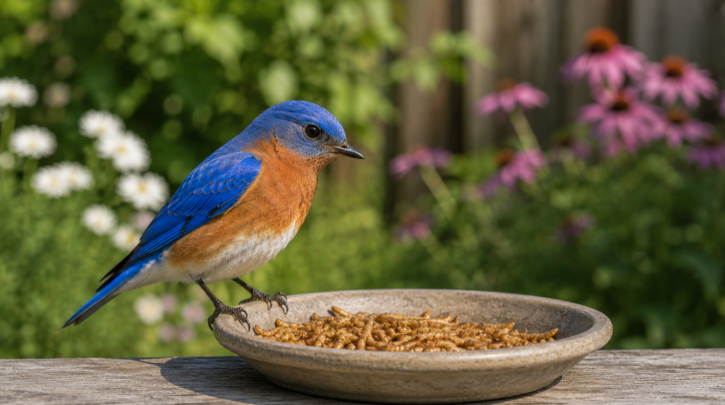

Mealworms are, without much competition, the single most effective food for attracting bluebirds to a feeder. But “mealworms” isn’t one product — live and dried versions behave very differently, and the choice between them affects everything from cost to how quickly bluebirds discover and return to your feeder.
Live Mealworms: The Gold Standard
Live mealworms are the most reliable option for actually attracting bluebirds, especially early on. Movement is a powerful visual trigger for a species that hunts by watching for motion, and a dish of wriggling mealworms will typically be discovered and visited far faster than a static dried alternative. Live mealworms also carry more moisture, which matters during hot weather or when feeding nestlings.
Downsides of Live Mealworms
- Require refrigeration or a cool spot to slow their life cycle and keep them from pupating into beetles
- Shorter shelf life than dried mealworms — typically a few weeks with proper care
- Higher cost per feeding compared to dried, especially at volume
Dried Mealworms: Convenient, Still Effective
Dried mealworms store at room temperature for months, don’t require any special care, and are the more practical choice for anyone not feeding daily. Once a local bluebird pair is already coming to a feeder, dried mealworms are generally accepted just as readily as live ones — the harder part is usually the initial discovery phase, where live movement helps.
A Practical Middle Ground
Many experienced bluebird hosts start a new feeder with live mealworms to establish the habit, then transition to dried mealworms, or a mix of both, once a pair is reliably visiting. Rehydrating dried mealworms briefly in water before offering them can also make them more appealing and easier for chicks to swallow.
The Calcium Problem
Mealworms alone are a nutritionally incomplete diet — they’re low in calcium relative to a growing chick’s needs, and a diet that’s too heavily mealworm-dependent during the nesting season has been linked to skeletal problems in nestlings. This risk applies mainly when a pair relies on feeder mealworms as a dominant food source rather than a supplement to wild insects.
- Offer mealworms in modest quantities rather than unlimited amounts, especially during active nesting
- Some hosts dust mealworms lightly with a reptile-grade calcium supplement during peak chick-rearing weeks
- Prioritize a yard that still supports plenty of wild insect prey, so mealworms remain a supplement, not the whole diet
How Much and How Often
A small dish of twenty to thirty mealworms offered once or twice a day is a reasonable starting point for a single active pair. Offering mealworms at consistent times — commonly mid-morning — helps a pair learn the routine and return reliably, which is especially useful during the demanding chick-feeding weeks.
Sourcing
Mealworms are sold through pet supply retailers, farm and feed stores, and specialty bird-feeding shops, both in bulk bags of dried mealworms and as live cultures shipped for local pickup or by mail. Buying in bulk during peak nesting season and storing dried mealworms in a sealed, cool, dry container is the most cost-effective approach for anyone feeding regularly across a full breeding season.
Ready to put mealworms out? See our mealworm feeder guide for the feeder designs that keep starlings and squirrels out while staying easy for bluebirds to use.
Freeze-Dried vs. Roasted Mealworms
Within the “dried” category, most commercial mealworms are freeze-dried rather than roasted or oven-dried, which better preserves nutritional content and results in a lighter, more brittle texture. Either processing method is generally fine for feeding bluebirds, though freeze-dried mealworms tend to rehydrate more readily if you choose to soak them briefly before offering them, which can make them easier for smaller chicks to swallow.
Avoiding Spoilage
Live mealworms left too long in warm, humid conditions can spoil, mold, or begin pupating into beetles, all of which reduce their appeal and food value. Keeping a live culture in a cool spot, checking it every few days, and only setting out enough for a single day’s feeding at a time avoids most spoilage issues. Dried mealworms should be stored in a sealed container away from moisture, where they’ll keep for many months without noticeable degradation.
Cost Comparison Over a Season
Live mealworms generally cost more per pound than dried, and that gap widens if you’re buying small quantities frequently rather than in bulk. For anyone feeding through a full breeding season, buying dried mealworms in bulk and reserving live mealworms for the initial attraction phase or peak chick-feeding weeks is usually the most cost-effective approach without sacrificing much attractiveness to the birds.