
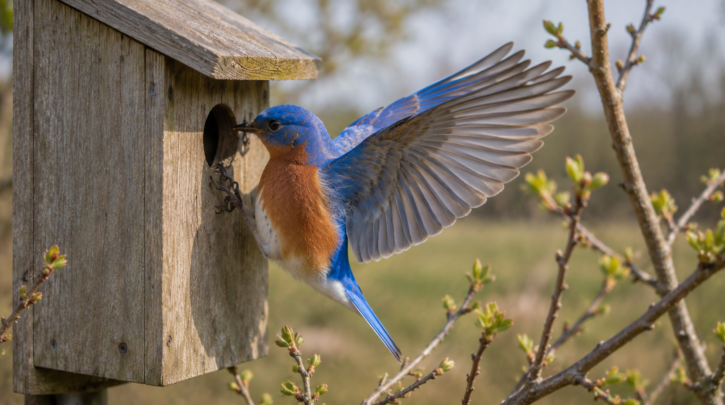

Spring is when a quiet winter flock breaks apart into paired, territorial couples, and it’s the single most important season for anyone hoping to attract a nesting pair. Timing your nest box prep to match this window makes a real difference in whether a box gets used.
Late Winter Into Early Spring: Scouting
Well before the first egg is laid, bluebirds begin scouting potential nest sites — checking existing cavities, investigating boxes, and re-establishing territories after a winter spent in loose, non-territorial flocks. In areas with resident populations, this scouting phase can start surprisingly early; in areas with returning migrants, it begins as soon as birds arrive back on the breeding grounds. See our migration guide for when that return typically happens by species and region.
Pairing and Courtship
Males arrive at or claim a nest site first in many cases and perform a wing-wave display at the entrance to attract a female, while singing persistently at dawn to advertise both the territory and his own availability. Once paired, the two birds spend time together at the chosen cavity before nest building actually begins — see our guide to bluebird calls for what this courtship song sounds like.
Sorting Out Males From Females in the Field
Spring is a good time to practice telling the sexes apart, since pairs are typically visible together at a chosen nest site. See our guide to male vs. female bluebirds for the plumage and behavior differences that make this easier.
Nest Building
Once a pair settles on a cavity, the female builds the nest cup almost entirely on her own, weaving fine dried grass into a compact, neatly rounded structure over the course of several days to about two weeks. A completed nest cup is usually a strong sign that egg laying will begin within days.
First Eggs of the Season
The first clutch of the year typically appears in mid-to-late spring, depending on latitude and whether the local population is resident or migratory. See our guide to bluebird eggs for clutch size, incubation length, and what a normal early-season clutch looks like.
Getting a Box Ready in Time
- Clean out any old nest material left over from the previous season
- Check the entrance hole for damage or enlargement from woodpeckers or squirrels
- Confirm the predator baffle is still securely in place on the pole
- Mount any new boxes well before scouting activity typically begins in your area
Watching for Early Competition
Spring is also when House Sparrow and House Wren competition for cavities is most intense, since every cavity nester in the area is scouting at once. See our guide to managing that competition if a box is being contested before bluebirds have a chance to claim it.
Once eggs appear, see our guide to baby bluebirds and fledging for the full hatching-to-fledging timeline that follows.
Regional Timing Differences
Exact spring timing varies considerably by latitude and species. Southern, resident Eastern Bluebird populations may begin nesting well ahead of northern migrants that haven’t even returned yet, while high-elevation Mountain Bluebirds on a late-melting mountain meadow can be several weeks behind a lowland population at the same latitude. Local timing is always a better guide than a single generic calendar date.
Weather Setbacks in Early Spring
A late cold snap or unexpected snowstorm after birds have already begun scouting or pairing can temporarily delay nest building, particularly in northern and high-elevation areas where spring weather is more variable. This kind of short setback is normal and doesn’t typically derail the season entirely — pairs generally resume nest building once conditions stabilize, sometimes just a few days behind where they would have otherwise started.
Monitoring Frequency in Spring
Once a pair has settled into a box, a calm check roughly once a week is a reasonable monitoring rhythm through nest building and early incubation. Checking too frequently in the first few days after a nest is completed is generally discouraged, since this is the period when a pair is most likely to abandon a site if repeatedly disturbed, even though the human-scent abandonment myth itself isn’t accurate.
What a Successful Spring Sets Up
A smooth, undisturbed spring — correct box, timely cleanout, minimal competition pressure — sets the stage for the demanding summer that follows, when the same pair will often attempt a second brood on top of raising the first. Getting the spring fundamentals right genuinely compounds across the whole season, and a pair that fledges a strong first brood on schedule is generally better positioned to attempt and successfully raise a second one before the season runs out.