
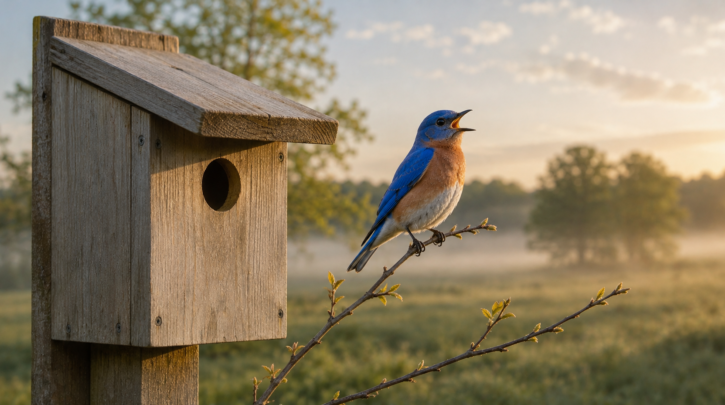

Bluebirds are quiet by songbird standards — you’re far more likely to spot one first and hear it second. But once you know the handful of sounds they make, their vocabulary is easy to recognize and genuinely useful for figuring out what’s happening around a nest box.
The Song: A Soft, Warbling ‘Tur-a-wee’
The male’s song is a low-volume, musical warble, often transcribed as “tur-a-wee, tur-a-wee” or “chiti WEEW wewidoo.” It’s soft enough that it carries only a short distance and is easy to miss under traffic noise or other birdsong. Males sing most persistently at dawn during the early breeding season, often perched near a chosen nest cavity, and the song functions both to attract a mate and to advertise the territory to rival males.
Contact Calls
Away from the nest, bluebirds keep in touch with soft, short “chur-lee” or “pew” contact notes, exchanged between a pair or among a family group after fledging. These are quieter and less musical than the song, functioning more like a check-in than a display.
Alarm Calls
When a predator, a competing House Sparrow, or a person gets too close to an active nest, bluebirds switch to a harsher, chattering alarm call — a rapid, scratchy series of notes very different in tone from the song. Hearing this near a nest box you’re monitoring is usually a sign to back off and give the pair space.
Begging Calls From Chicks
Nestlings produce a thin, insistent buzzing or peeping sound whenever a parent arrives with food — audible from several feet away once chicks are a week or so old, and one of the easiest ways to confirm a box is actively being fed without opening it.
Why Bluebirds Are Quieter Than Other Thrushes
Compared to their thrush relatives like the American Robin or Wood Thrush, bluebirds have a noticeably subdued vocal repertoire. Ornithologists generally attribute this to their reliance on cavity nesting: a loud, far-carrying song is less necessary for a species that already advertises ownership of a specific, visible nest hole rather than a broad open territory.
Recognizing Bluebirds by Ear Alone
- Soft, musical warble = territorial or courtship song (usually male)
- Short, quiet single notes = contact calls between pair members
- Harsh, rapid chattering = alarm call, predator or intruder nearby
- Thin buzzy peeping from inside a box = chicks begging at a feeding visit
If you’re hearing chattering alarm calls near your box, check our guide to House Sparrow and Starling competition — it’s one of the most common triggers.
Regional and Individual Variation
Like most songbirds, individual bluebirds show some variation in exactly how their song is phrased, and there’s modest regional variation across the range of each species as well. The overall pattern — a soft, low-volume, musical warble — holds consistently across Eastern, Western, and Mountain Bluebirds, but the exact syllables and their order aren’t identical bird to bird, the same way no two people say a phrase with exactly the same cadence.
How Song Timing Shifts Through the Season
Singing activity isn’t constant across the year. It peaks in early spring as males establish territories and attract mates, tapers off once a pair is incubating, and can pick back up briefly between broods if the pair attempts a second nesting cycle later in the season. By late summer, once breeding activity winds down, singing becomes noticeably less frequent, and the calls you hear are far more likely to be simple contact notes than full song.
Using Sound to Find a Nest Box Location
Experienced bluebird trail monitors often listen as much as they look when scouting a new box location. A singing male perched near an existing cavity or a prospective box site is a strong early signal of interest, sometimes appearing before any visible nest-building activity begins. Conversely, persistent alarm chattering directed at a box that already has activity is worth investigating promptly — it often means a predator or a competing cavity nester like a House Sparrow is causing a disturbance.
Recordings and Apps
For anyone new to identifying bluebirds by ear, birding apps with sound-identification features and online reference libraries of bird calls are useful for building familiarity before heading outside. Listening to a few confirmed Eastern, Western, and Mountain Bluebird recordings back to back is usually enough to lock in the distinctive soft, warbling quality that sets bluebird song apart from louder, more assertive thrush relatives like the American Robin. A few focused listening sessions before your next walk will make picking a bluebird out of a mixed dawn chorus far easier.