
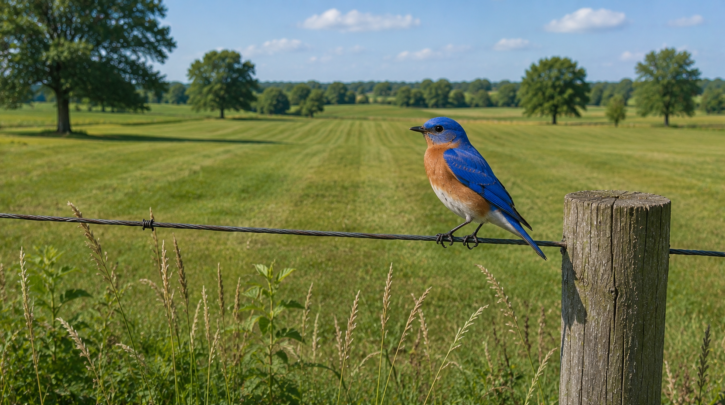

All three bluebird species share one non-negotiable habitat requirement: open country. Whatever else differs between Eastern, Western, and Mountain Bluebirds, none of them thrive in dense, unbroken forest — they need short ground vegetation for hunting insects and scattered perches or cavities nearby for nesting.
Eastern Bluebird Range
The Eastern Bluebird occupies the entire eastern half of North America, from southern Canada down through the eastern and central United States into parts of eastern Mexico and Central America. It’s a year-round resident through most of the southern and central portions of that range, with northern populations shifting south for winter.
Western Bluebird Range
The Western Bluebird sticks to the western third of the continent — the Pacific coast states, the Southwest, and interior mountain woodlands from California and Oregon east through Nevada, Arizona, New Mexico, and Colorado, extending south into Mexico. It favors oak savanna, open pine woodland, and burned or logged forest with standing dead trees that provide natural nesting cavities.
Mountain Bluebird Range
The Mountain Bluebird is the most northerly and high-elevation of the three, breeding as far north as Alaska and the Yukon and south through the Rocky Mountains and Great Basin. It winters primarily across the southwestern United States and northern Mexico, often in open plains and desert grassland far from any mountains at all.
Habitat Preferences by Species
- Eastern Bluebird: farmland edges, orchards, golf courses, large mowed lawns, pastures with scattered trees
- Western Bluebird: oak savanna, open pine forest, recently burned or logged woodland with dead standing trees
- Mountain Bluebird: high alpine meadows, sagebrush flats, and open prairie — the most comfortable of the three well away from any tree cover at all
Where Ranges Overlap
The interior West is the main zone where two or even all three species can occur in reasonably close proximity, particularly where Western and Mountain Bluebird ranges meet across the Rockies and Great Basin. See our identification guide for how to tell them apart when range alone doesn’t settle the question.
Elevation Matters for Mountain Bluebirds
Mountain Bluebirds breed at higher elevations than the other two species, sometimes well above treeline in alpine meadows during summer, then drop to much lower elevations — often flat, open desert or plains habitat — for winter. This elevational shift is a normal part of their annual cycle rather than true long-distance migration in every case.
What Attracts a Bluebird to a Specific Yard
Within any of these broader ranges, a property is far more likely to attract bluebirds if it offers open ground for hunting, at least a few scattered perches, and either an existing natural cavity or a properly sized nest box. See our guide to attracting bluebirds for the specifics on turning suitable regional habitat into an actual nesting site.
Want to know whether bluebirds stick around your area year-round or head south for winter? See our guide to bluebird migration for the species-by-species breakdown.
Habitat Loss and Recovery
Historical habitat loss — particularly the removal of dead standing trees that once provided natural nesting cavities, combined with competition from introduced species — drove significant Eastern Bluebird declines through the mid-20th century. Organized nest-box trails across farmland and open country have been a major factor in the species’ recovery since then, effectively replacing lost natural cavities with artificial ones in otherwise suitable open habitat.
Microhabitat Details Within a Region
Even within a broadly suitable region, small habitat details make a real difference. Bluebirds favor short grass over tall, unmowed growth, since dense tall grass makes ground-dwelling insect prey much harder to spot from a perch. A mowed lawn, pasture, or regularly grazed field within sight of a nest box is generally more productive hunting ground than an overgrown or heavily brushy area, even if that brushy area sits in an otherwise appropriate range.
Edge Habitat and Perch Availability
All three species do best along the edge between open ground and some form of elevated perch — fence lines, utility wires, isolated trees, or low shrubs scattered across an otherwise open field. A truly featureless, perch-free expanse of open ground is actually less productive than a field with scattered perch points every so often, since bluebirds rely on those perches for their characteristic watch-and-pounce hunting style.
Urban and Suburban Limitations
Densely built urban environments generally don’t support bluebirds well, mainly due to a lack of open hunting ground and heavy competition from House Sparrows, which thrive in exactly that kind of environment. Suburban properties with larger lots, open lawn space, and some distance from dense downtown cores tend to have meaningfully better luck attracting bluebirds than urban core locations.