
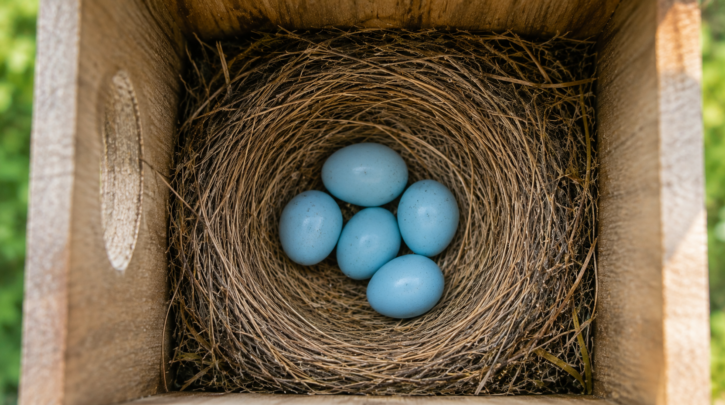

If you’ve opened a nest box and found a small clutch of pale blue eggs nestled in a neat cup of fine grass, you’ve very likely found an active bluebird nest. Here’s what’s normal, and what the timeline from laying to hatching actually looks like.
This site participates in affiliate programs. If you buy through a link on this page, we may earn a commission at no extra cost to you. Affiliate disclosure
Egg Color
Bluebird eggs are typically a pale, powdery blue, though white eggs occur in a small percentage of clutches — roughly five percent or so across the species, and slightly more common in some local populations than others. White-egg clutches are a normal genetic variation, not a sign of illness or a different species.
Clutch Size
A typical clutch contains four to six eggs, most commonly five, laid one per day, usually in the early morning. The female lays until the clutch is complete and only then begins full incubation — this delay means all the eggs in a clutch tend to hatch within roughly a day of each other, rather than in the order they were laid.
Incubation
- Incubation is done entirely by the female
- Duration: 12 to 14 days from the start of full incubation to hatching
- The male does not incubate but often feeds the female on the nest during this period
What’s Happening Before Incubation Starts
Between completing the nest and laying the final egg, there’s often a short gap where the box appears to have eggs but no adult sitting on them for extended periods — this is normal and doesn’t mean the clutch has been abandoned. Full-time incubation typically doesn’t begin until the last egg is laid.
Multiple Broods
Bluebird pairs commonly raise two broods in a single season, and in the southern part of the Eastern Bluebird’s range, occasionally three. After the first brood fledges, the female often begins building a new nest for the second clutch fairly quickly, sometimes while the male is still feeding recently fledged young from the first brood.
If You Find an Unattended Clutch
A clutch left alone for short stretches during the day, especially before incubation is complete, is normal and not a cause for concern. If eggs appear cold and clearly abandoned for an extended period — generally more than a day with no adult activity at the box — that can indicate the pair has been lost to a predator or has abandoned the nest, most often due to House Sparrow interference. See our guide on managing that competition if you suspect it’s the cause.
Monitoring Without Harming a Clutch
A brief, calm check once a week during incubation is generally considered safe and won’t cause a female to abandon her eggs — contrary to a common myth, birds don’t abandon a nest because of human scent. Keep visits brief, avoid checking during storms or extreme heat, and close the box gently when finished.
Eggs about to hatch? See our guide to baby bluebirds and fledging for what happens next, from hatching through leaving the nest.
A camera nest box like the Birdfy Nest Duo lets you check on the eggs as often as you like without opening the box at all.
How Nest Cup Construction Relates to Egg Laying
The female builds the nest cup almost entirely on her own, weaving fine dried grasses into a compact, neatly rounded cup that typically takes anywhere from a few days to about two weeks to complete depending on weather and how motivated the pair is. Egg laying generally begins once the cup is essentially finished, which is why a box that suddenly shows a completed grass nest is often a strong sign eggs will appear within the next several days.
Distinguishing Bluebird Nests From Other Species
A bluebird nest cup is neat, tightly woven, and made almost entirely of fine grass with little other material mixed in — a useful identifying feature when checking a box, since it looks quite different from the bulkier, twig-and-debris nests built by House Sparrows or the stick-filled cavities House Wrens sometimes create. Recognizing this difference at a glance helps when monitoring boxes for signs of competition.
What Happens If an Egg Doesn’t Hatch
It’s common for one egg in a clutch to fail to hatch even when the rest of the clutch succeeds, whether due to infertility or a developmental issue. A single unhatched egg remaining in the nest after the rest of the brood hatches is normal and not typically a cause for concern; it’s generally left alone by the parents and can be removed by a monitor once the rest of the brood has fledged and the box is being cleaned out for the next attempt.
Comparing Bluebird Eggs to Other Cavity Nesters
Egg color alone isn’t always a reliable way to confirm a bluebird nest, since Tree Swallows — a common box-sharing species — also lay pale, unmarked eggs, though theirs run slightly more white than the powdery blue typical of bluebirds. House Wren eggs, by contrast, are small and heavily speckled with reddish-brown, making them easy to distinguish at a glance. Combining egg appearance with nest cup material — fine grass for bluebirds, feathers mixed in for swallows, sticks for wrens — gives a much more reliable identification than color alone.