
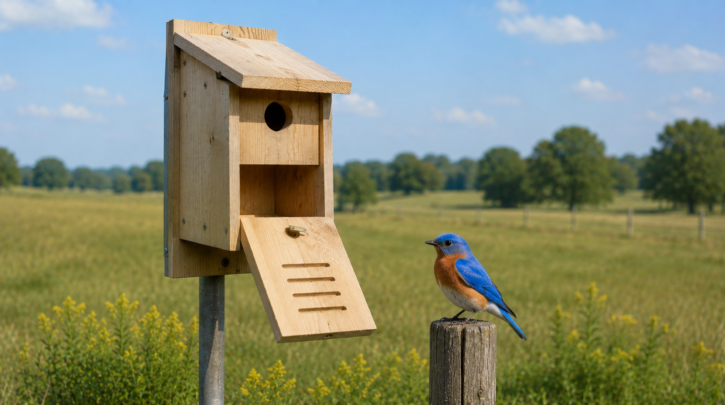

Not every birdhouse sold as a “bluebird box” actually meets the dimensions bluebirds need. Our top pick is the Birdfy Nest Duo, a camera nest box that lets you follow a nesting season from your phone, followed by two simpler wooden boxes. Before getting into specific picks, it’s worth reiterating what to check on any box you’re considering — see our full nest box guide for the complete rundown on hole size, floor dimensions, and mounting.
What We Looked For
- Correct 1½-inch entrance hole (or slightly larger for Mountain Bluebird ranges)
- No perch below the entrance, which mainly benefits House Sparrows
- A front- or side-opening panel for easy monitoring and end-of-season cleaning
- Ventilation and drainage built into the design
- Untreated wood construction — cedar or pine, not painted dark colors or metal
Birdfy Nest Duo: Our Top Pick
The Birdfy Nest Duo is a nest box with two cameras, one inside the cavity and one outside facing the entrance, plus built-in audio. That means you can watch nest building, eggs, hatchlings, and fledging from your phone without opening the box, which cuts down on the disturbance that routine manual checks involve. It ships with four entrance plates, including the standard 1½-inch size for Eastern and Western Bluebirds, and metal guards around the entrance to discourage predators from enlarging the hole.
Because it’s a camera box, it needs a spot within range of your home Wi-Fi, and it sits at the top of the price range for a single box. For a backyard pair you want to watch closely, it’s the most rewarding option on this list. You can check current pricing for the Birdfy Nest Duo on Birdfy’s site, and our nest box camera guide covers installation timing and power in more detail.
Runner-Up: Duncraft Gilwood Bluebird Nest Box
Built from Eastern white pine with a wide oval entrance and shallow interior design specifically shaped to discourage House Sparrows, which tend to find the entrance style unappealing compared to a standard round hole. It ships with a 72-inch sectional pole, and grooved rain guards under all four sides of the roof keep the nesting cavity dry in wet weather — a nice detail for anyone in a rainier climate.
Also Good: Duncraft Well-Vented Bluebird Nestbox
As the name suggests, ventilation is the standout feature here — generous 3/8-inch openings keep the box from overheating in direct summer sun, which matters most in warmer regions where afternoon heat can be a genuine risk to nestlings. It includes a wire grid ladder inside to help fledglings climb to the entrance when they’re ready to leave, and mounts flush against a post, tree, or building.
Duncraft Bluebird Manor House
A more decorative option built from solid cypress with a stone-washed shingled roof, but don’t let the styling fool you — it still hits the functional basics with a correct 1½-inch entry hole, drainage holes, and a front-opening panel for easy inspection. A good choice for anyone who wants a nest box that also looks intentional as a yard feature.
What to Pair With a New Box
A nest box alone is only part of the setup. Placing a mealworm feeder nearby cuts down on the distance parents travel to feed chicks — see our mealworm feeder picks — and a smooth metal pole with a predator baffle protects whichever box you choose from climbing predators, regardless of which model you go with.
A Note on DIY Boxes
Building your own box is a completely valid option and often cheaper than buying one, as long as you stick closely to the dimensions in our nest box guide — correct hole size, adequate depth, ventilation, and drainage matter far more than the specific brand or material, provided untreated wood is used.
Already have a box up? Check our nest box camera guide if you want to watch the nesting season unfold without disturbing the pair.
Choosing Between Wood Types
Cedar and pine are both common, untreated choices for bluebird boxes, and either works well. Cedar naturally resists rot and insects slightly better without any chemical treatment, which can extend a box’s outdoor lifespan by a few seasons compared to untreated pine, though pine boxes are generally less expensive and perform just as well functionally for the birds themselves.
Pole and Baffle Setup
None of the boxes above come pre-paired with a pole baffle — even the Nest Duo’s metal entrance guards don’t replace one — and this is genuinely worth budgeting for separately. A smooth metal pole combined with a stovepipe or cone-style baffle mounted below the box is the single most effective, lowest-cost predator deterrent available, and it’s worth prioritizing over almost any other accessory purchase for a new box.
Sizing for Mountain Bluebird Territory
If you’re setting up in Mountain Bluebird range, double-check the specific hole diameter on any box before buying — some models are sized at the standard 1½-inch Eastern/Western specification rather than the slightly larger 1 9⁄16-inch opening Mountain Bluebirds sometimes need, particularly in areas without a resident Eastern or Western population competing for the same cavity.
Budget Considerations
Prices for a well-built bluebird box range widely depending on materials, included pole hardware, and features. A camera box like the Nest Duo sits at the top of that range, since you’re paying for the cameras and app as much as the box. A basic, functional wooden box without a pole is the most economical entry point if you already have a suitable mounting setup, while a complete box-and-pole kit saves the trouble of separately sourcing compatible mounting hardware.
Multiple Boxes for a Trail
Anyone setting up more than one or two boxes — effectively starting a small nest-box trail — benefits from standardizing on a single model across all locations. Consistent hole size, interior dimensions, and opening mechanism make routine monitoring faster and reduce the chance of a mismatched box accidentally excluding the species it was meant to attract.