
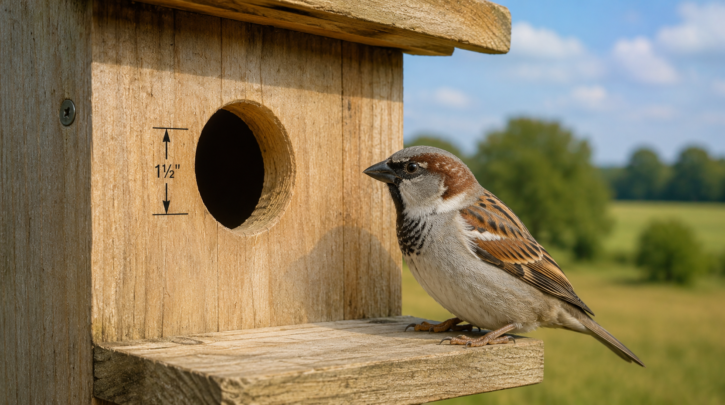

If there’s one factor that has shaped bluebird population history more than any other, it’s competition for nest cavities from two introduced, non-native species: the House Sparrow and the European Starling. Understanding how each one threatens bluebirds, and what you’re legally and practically able to do about it, is essential for anyone running a nest box.
European Starlings: Mostly a Non-Issue With the Right Hole
European Starlings are simply too large to fit through a correctly sized 1½-inch entrance hole, which makes hole diameter the single most effective defense against them. Starlings become a problem almost exclusively when a hole has been cut too large, either by design or by woodpeckers or squirrels enlarging an existing hole over time — a good reason to check hole diameter periodically on any box that’s been up for several seasons.
House Sparrows: The Harder Problem
House Sparrows are the far more serious threat, because they’re small enough to fit through the same 1½-inch hole that’s sized for bluebirds. Unlike starlings, hole size alone won’t exclude them. House Sparrows are also aggressive competitors: they’re documented attacking and killing adult bluebirds inside a box, destroying eggs, and killing nestlings in order to take over a cavity, then building their own messy, trash-lined nest on top.
Signs of a House Sparrow Takeover
- A bulky, disorganized nest of grass, feathers, and debris, very different from a bluebird’s neat woven grass cup
- Dead or injured adult bluebirds found in or near the box
- Punctured or missing eggs
- A male House Sparrow — chunky-bodied, black bib, gray cap — perched persistently near the box
Management Options for House Sparrows
- Site boxes away from buildings, barns, and feedlots — House Sparrows strongly prefer nesting close to human structures and livestock areas, while bluebirds favor more open country
- Remove House Sparrow nests repeatedly and promptly — because House Sparrows are a non-native, unprotected species in the United States, removing their nests, eggs, or the birds themselves from a nest box is legal, unlike removing a protected native species
- Sparrow-resistant box designs, such as slot-entrance boxes, are sometimes used on heavily pressured trails to reduce (though not eliminate) House Sparrow use
- In-box or ground traps designed specifically for House Sparrows are used by some experienced trail monitors as a more active management tool
House Wrens: A Different, Trickier Case
House Wrens are sometimes confused with House Sparrows as a nest-box threat, but they’re a native species and legally protected, which changes the management approach entirely. Wrens are known to puncture bluebird eggs and fill boxes with sticks to make them unusable by other species — a natural competitive behavior rather than anything comparable to the House Sparrow problem. Because wrens favor brushy, wooded edge habitat, the most effective management is simply keeping bluebird boxes well out into open ground, away from the shrubby cover wrens prefer.
Legal Note
House Sparrows and European Starlings are both introduced species and are not protected under the Migratory Bird Treaty Act in the United States, which is why active removal is legal for these two species specifically. Every native songbird, including House Wrens, is protected, and nests, eggs, or birds of a native species should never be disturbed or removed. Always confirm identification carefully before taking any action, since mistaking a native species for a House Sparrow is a real risk for less experienced trail monitors.
Managing sparrows successfully starts with the box itself — see our nest box guide for hole sizing and siting details that reduce pressure before it starts.
Why This Competition Is a Historical Problem
Both House Sparrows and European Starlings are Old World species deliberately introduced to North America in the 19th century — House Sparrows in the 1850s and starlings in the 1890s — and both spread rapidly across the continent with no natural checks on their population growth. Native cavity nesters like bluebirds, which evolved without any pressure from these two species, had no existing defenses against the aggressive, high-density competition that followed, and bluebird populations declined substantially through the early-to-mid 20th century as a direct result.
The Nest-Box Trail Movement as a Response
The organized bluebird nest-box trail movement that took off in the 1960s and continues today was built specifically around addressing this competition — correctly sized boxes to exclude starlings, careful siting away from human structures to reduce House Sparrow pressure, and active monitoring to catch and remove House Sparrow nests before they can cause damage. That sustained, coordinated effort is a major reason bluebird populations have recovered substantially since their mid-century low point.
A Realistic Expectation
No single management step eliminates House Sparrow pressure entirely, especially in areas near farms, barns, or dense residential development where sparrow populations are already high. Combining good site selection with consistent, repeated nest removal produces the best long-term results, and most experienced trail monitors treat sparrow management as an ongoing seasonal task rather than a one-time fix.