
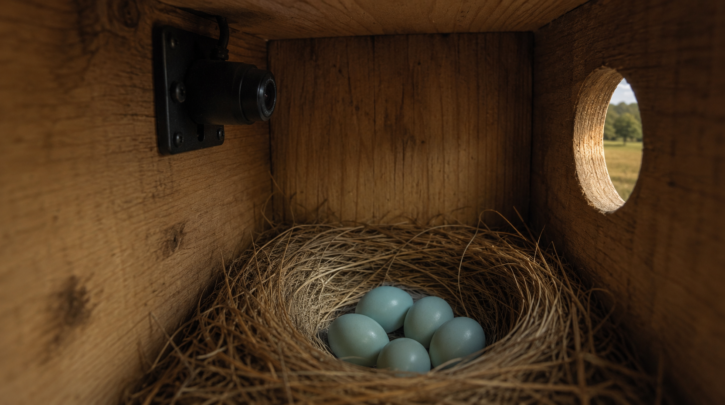

A nest box camera turns nest monitoring from a weekly guess into a genuine window on everything happening inside — egg laying, hatching, feeding visits, and fledging, all without opening the box or disturbing the pair.
What to Look For
- Infrared night vision that doesn’t emit a visible glow, so it won’t disturb birds after dark
- A wide-angle, close-focus lens built for a small enclosed space rather than a standard outdoor security camera lens
- Reliable WiFi or app connectivity for remote viewing on a phone or tablet
- A compact form factor that doesn’t meaningfully shrink the usable nesting space inside the box
Birdfy Nest Duo
A complete smart nest box with an integrated dual camera setup covering both the interior nest cup and the entrance hole, giving a full view of birds arriving, feeding, and eventually fledging. The app includes AI-assisted species and activity recognition, and the box itself is built to standard cavity-nester dimensions rather than being a generic add-on camera retrofitted into an existing house.
See: Birdfy Nest Duo
Retrofitting an Existing Box
If you already have a nest box up and don’t want to replace it, a standalone camera module designed for retrofitting is the more practical route. These compact units mount inside an existing wooden box, typically requiring a small cable channel drilled for power and a mounting bracket screwed into the interior wall — a bit more setup work than an all-in-one kit, but it lets you keep a nest box you’ve already established as active.
Installation Timing Matters
Install and fully test any camera setup well before the breeding season begins, ideally during the same late-winter window when boxes should already be cleaned out and ready. Installing or adjusting a camera in an already-active box risks disturbing a nesting pair, and in the worst case can cause nest abandonment during the sensitive early incubation period.
Power and Connectivity Considerations
WiFi range at the box’s actual outdoor location is worth checking before committing to a WiFi-dependent camera — a box mounted well out into open ground, which is exactly where bluebirds prefer to nest, can sit right at the edge of a home network’s effective range. Solar-powered options remove the need to run a power cable to a remote box, at the cost of slightly more setup complexity than a simple plug-in model.
Pair a camera with a properly sized box for the best of both worlds — see our nest box picks if you’re starting from scratch.
What You’ll Actually See Over a Season
A camera-equipped box typically captures the full arc covered in our baby bluebirds guide — nest construction, egg laying, roughly two weeks of incubation, and another two to three weeks of feeding visits before fledging — making it one of the more rewarding ways to follow a single nesting attempt start to finish.
Storage and Footage Management
Most nest box cameras record to a microSD card, an app-connected cloud service, or both, and it’s worth checking storage capacity and any subscription requirements before buying, particularly if you plan to leave the camera recording continuously through an entire nesting cycle rather than only checking in periodically.
Battery vs. Wired Power
A wired camera avoids battery management entirely but requires running a power cable to the box location, which can be impractical for a box mounted well out into open ground away from any structure. Solar-powered or battery-backed models solve that placement problem but need occasional checks to confirm the battery or solar panel is keeping up with actual usage, especially during long stretches of overcast weather.
Avoiding Disturbance
Whatever setup you choose, minimizing disturbance during installation is the priority. Mount and fully test the camera before a pair has committed to the box, and avoid opening or adjusting the camera once eggs have been laid — the same disturbance principles that apply to manual monitoring apply just as much to a camera installation, even though the ongoing footage itself causes no disturbance once it’s properly set up.
Sharing Footage Responsibly
Many nest box camera owners enjoy sharing clips of hatching or fledging with family, friends, or local birding groups, which is a great way to build interest in bluebird conservation. Just keep in mind that overly frequent flash photography or bright supplemental lighting near an active box can stress nesting birds, so stick to the camera’s built-in infrared night vision rather than adding external lighting for better nighttime footage, which does far more to preserve natural, undisturbed nesting behavior than it costs in footage quality.