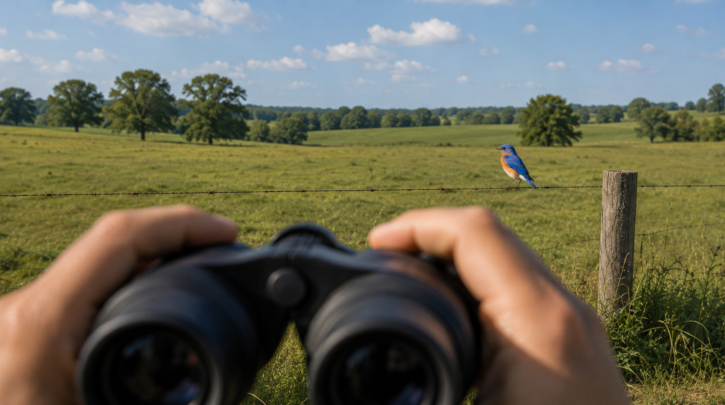

A bluebird sitting on a fence wire eighty yards across an open pasture and a bluebird perched on the roof of a nest box twenty feet from your porch are the same species, but they’re not the same optical problem. Most binocular buying guides hand you one generic spec list — 8x, 42mm, done — without asking where you’ll actually be standing when you lift them to your eyes. For a species that’s just as often watched from a car window along a rural road as it is from a lawn chair by the nest box, that distinction matters more than the usual checklist.
Three Ways People Actually Watch Bluebirds
Bluebirds are open-country birds by nature — pastures, orchards, golf courses, cemetery edges, and fence lines, not dense woods — and that habitat shapes viewing distance more than almost any other factor. Below are the three settings that cover most of how bluebird hosts and birders actually use their binoculars, and the spec priorities shift meaningfully between them.
Scenario 1: Backyard Nest Box Monitoring
This is the closest-range scenario by far — watching a box from a porch, window, or lawn chair somewhere between 15 and 40 feet away, often for a stretch of time while waiting to confirm which adult is on box duty or whether a fledgling has appeared at the hole. At this distance, raw light-gathering power matters far less than it does out in open habitat, and a close minimum focus distance becomes the spec that actually determines whether the binoculars are useful at all — a pair that can’t focus under 15 feet is frustrating for exactly this kind of close, stationary watching.
Weight matters here too, but for a different reason than in the field: sessions tend to be long and seated, so a lighter compact pair that won’t tire your arms during a slow afternoon of box-watching is worth more than the largest possible objective lens.
Scenario 2: Scanning Open Meadows, Orchards & Golf Courses
This is where bluebirds are most often first spotted, and it’s also the scenario the generic “8×42 is the sweet spot” advice serves worst. A bluebird on a distant fence wire across a pasture or orchard row is frequently 50 to 150 yards out, small against a lot of open sky and grass, and easy to lose entirely in a narrow field of view. Two specs matter more here than anywhere else: a larger objective lens (42mm and up) to pull in enough light to resolve real color and shape at that distance rather than a vague dark speck, and a genuinely wide field of view so you can sweep a fence line or tree row without constantly losing your place.
Magnification is where 10x starts to earn its keep in this setting specifically. At nest-box range, 10x mostly just amplifies hand shake for no real benefit — but at 80 or 100 yards, the extra reach is often what turns “there’s definitely a bird there” into an actual identification of throat color and back pattern.
Scenario 3: Watching From a Car Along Rural Roads
Road birding is its own category of challenge. You’re glassing through an open window, often with the vehicle providing the only brace you’ve got, and needing to reacquire a bird quickly before it flushes or you need to move on to avoid blocking a rural road. A wide field of view is arguably even more important here than in open-field scanning, since there’s no time to hunt around for a bird you’ve already spotted with your naked eye once your binoculars are up. A moderate 8x, rather than 10x, is usually the more forgiving choice from a vehicle, since the added magnification of a 10x pair makes hand shake more noticeable without a solid brace — and a car door or window frame is a much less stable rest than standing on open ground with both feet planted.
A quick-turning focus wheel matters more for this scenario than any other, since birds along a roadside are typically spotted, glassed, and gone within seconds, not watched at leisure the way a box or a distant pasture bird often is.
Matching Binocular Specs to Where You’re Watching
| Scenario | Magnification | Objective lens | Field of view priority | Why |
|---|---|---|---|---|
| Backyard nest box | 8x | 32–42mm | Moderate | Close focus under 15 ft matters more than reach; birds are already close and often stationary |
| Open meadow / orchard / golf course | 10x | 42–50mm | High | Long-range light-gathering and a wide sweep are what actually resolve a bird on a distant fence wire |
| Roadside / car birding | 8x | 42mm | Very high | Fast reacquisition and hand-shake forgiveness from an unstable, window-braced position |
If You Only Want One Pair
Most hosts don’t want three binoculars, and a single 8×42 pair genuinely does cover all three scenarios reasonably well — it’s the closest thing to a universal compromise in birding optics, which is exactly why it shows up so often as the default recommendation. Where that compromise shows its limits is in Scenario 2: if most of your bluebird watching happens scanning open pasture or orchard habitat rather than a backyard box, stepping up to a 10×42 is worth the trade-off in hand-shake sensitivity for the extra reach on a fence-line bird at real distance.
Close Focus Still Matters, Just Not Everywhere
The original case for a close focus distance under 8 to 10 feet holds fully true for backyard nest-box watching, where a bird can genuinely be that close. It matters far less in the other two scenarios, where the shortest realistic distance to a bird is still tens of yards — a spec worth checking specifically for hosts whose bluebird watching is mostly at the box rather than in open habitat.
Roof Prism vs. Porro Prism, by Scenario
Most modern birding binoculars use a roof prism design, which is more compact, generally more durable, and easier to weatherproof than the older porro prism style. Porro prism models can offer a wider field of view and a slightly better sense of depth at a given price point, which makes them worth a look specifically for open-meadow scanning, where field of view is already the priority — though roof prism remains the easier choice to carry comfortably for long trail-monitoring sessions or quick grab-and-go car birding.
Weight for Extended Trail Monitoring
Anyone monitoring a multi-box trail is really combining Scenario 1 and Scenario 2 across a single outing — close looks at each box, plus scanning the open habitat between stops for perched adults. A full-size 8×42 or 10×42 held for an hour or more across several stops is where weight becomes genuinely noticeable, and a harness-style strap that distributes the load across both shoulders rather than the neck alone is worth the small extra cost for this kind of extended, start-and-stop use.
Key Features Worth Checking Regardless of Scenario
- ED (extra-low dispersion) glass for sharper, truer color rendition — genuinely useful for telling subtle blue and rust tones apart between species at any distance
- Waterproof and fog-proof construction, since bluebird activity peaks at dawn and dusk when dew and condensation are common
- Sufficient eye relief if you wear glasses while birding
- A focus wheel that turns smoothly and predictably, which matters most for the roadside scenario where speed is everything
Where to Buy
B&H Photo carries a wide range of birdwatching binoculars across price points, with detailed spec filtering that makes it easier to compare magnification, objective lens size, and field of view side by side before buying.
Put Them to Use
Once you’ve matched a pair to how you actually watch, the payoff is a stable, resolvable view for confirming what you’re looking at — the throat-color and back-pattern comparisons in our species identification guide are far easier to apply with a clear, steady image than with a shaky or narrow one. And for anyone splitting time between the box and the open field, the habitat and range guide is a useful reference for where to expect birds in each setting.
Caring for Your Binoculars
A simple lens cloth and occasional careful cleaning of the objective and eyepiece lenses keeps image quality sharp over years of use. Keeping the lens caps attached when not in active use prevents most of the dust and smudging that gradually degrades clarity, and storing binoculars in a padded case — rather than left in a hot car, which is an easy mistake for anyone doing regular roadside or trail birding — protects both the optics and any rubber armoring from premature wear.