
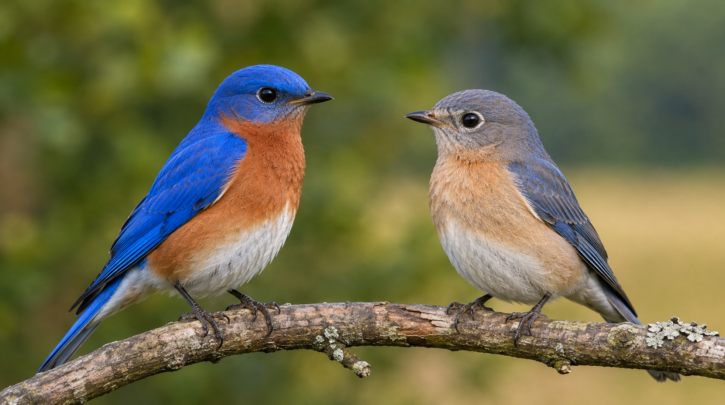

Across all three bluebird species, the pattern is the same even though the colors differ: males are the bright, saturated version, and females are a muted, softer echo of the same design. Once you know what to look for, sexing a bluebird at the feeder or the nest box takes seconds.
This site participates in affiliate programs. If you buy through a link on this page, we may earn a commission at no extra cost to you. Affiliate disclosure
The General Rule: Brightness and Contrast
Male bluebirds carry deep, richly saturated blue on the head, back, wings, and tail, with sharp contrast against any orange or white on the underside. Females show the same color pattern in outline — blue wings and tail, an orange wash on the breast in Eastern and Western birds — but every color is diluted. A female’s blue often reads as gray-blue or slate, especially on the head and back, with the vivid blue mostly restricted to the wings and tail.
Eastern Bluebird
- Male: vivid blue upperparts, bright rust-orange throat and breast, crisp white belly
- Female: gray-brown head and back, pale orange breast, blue limited mostly to wings and tail
Western Bluebird
- Male: blue head and throat, rusty breast and back patch, strong color contrast
- Female: overall gray-blue wash, faint rust tone on the breast, back patch barely visible
Mountain Bluebird
- Male: uniform sky-blue from head to tail, no orange at all
- Female: plain gray-brown body with a soft pale-blue wash confined to wings and tail — the most subtly marked female of the three, and easy to mistake for a sparrow at a glance
Behavior Can Help Too
During the breeding season, males typically arrive at a nest site first and perform a wing-wave display at the cavity entrance to attract a female. Once paired, females do the bulk of nest building and all of the incubating, so a bluebird spending long stretches inside a box is almost always the female. Males, meanwhile, spend more time perched nearby on guard and delivering food to the incubating female and later the chicks.
Why the Difference Exists
The brighter male plumage is a product of sexual selection — brighter, higher-contrast color signals condition and fitness to a prospective mate, while the female’s duller plumage provides better camouflage while she spends long hours sitting on eggs inside a dim cavity. It’s the same evolutionary logic seen across most North American songbirds with visible sexual dimorphism.
Telling Juveniles From Adult Females
This is where people get tripped up. Juvenile bluebirds of both sexes are heavily spotted on the breast, which no adult female shows. A spotted breast means a young bird of the year, not an adult female — regardless of how dull or bright the wing color looks.
Watching a pair choose a nest site? Our nest box guide covers the hole sizes and placement details that make a box attractive to a prospecting female.
Molt and Seasonal Plumage Changes
Unlike some songbirds that show a dramatically different breeding versus non-breeding plumage, adult bluebirds keep roughly the same coloring year-round. What does change is feather wear: by late summer, after a full breeding season of nest-building, feeding trips, and general wear and tear, both sexes can look slightly duller and scruffier than they did in early spring, right after the complete post-breeding molt refreshed their plumage the previous fall.
First-Year Males Can Look Intermediate
A male bluebird in its first breeding season, only months removed from spotted juvenile plumage, sometimes shows slightly less saturated color than an older, fully mature male — a subtle difference that’s more noticeable side-by-side than in isolation. This is one reason experienced nest-box monitors avoid making firm age or sex calls from a single quick look and instead watch a bird’s behavior over several visits.
Using Sex to Interpret Nest-Box Activity
Knowing which sex you’re looking at makes nest-box monitoring far more informative. A female spending extended time inside the box in early spring is likely building the nest cup or laying eggs. A male perched nearby, singing or making short trips to and from the box with food in his bill, signals an active nest with either an incubating female or hungry nestlings inside. Distance monitoring — watching from outside without opening the box — relies heavily on being able to sex the adults correctly, since it lets you track nesting progress without disturbing the pair.
A camera nest box like the Birdfy Nest Duo makes distance monitoring even easier: its outside camera records each trip to the entrance, and its inside camera shows what’s happening in the nest.
When Sex Is Genuinely Hard to Call
In poor light, or with a fast-moving bird glimpsed only briefly, even experienced birders sometimes can’t confidently sex a bluebird from color alone. In those cases, behavior is the tiebreaker: a bird that disappears into a cavity and stays put is almost certainly the female, while a bird that perches, sings, or makes repeated short flights without entering is more likely the male.