
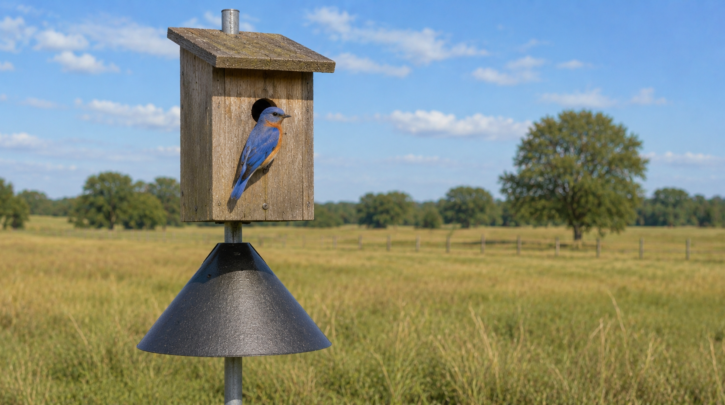

Because bluebirds can’t excavate their own nesting cavities, a nest box is often the single most impactful thing a homeowner can do for them — but only if the box is built and placed correctly. Get the hole size wrong and you invite House Sparrows instead. Get the mounting wrong and you invite predators. This guide covers the specifics that actually matter.
Entrance Hole Diameter
- Eastern Bluebird: 1½ inch (1.5″)
- Western Bluebird: 1½ to 1 9⁄16 inch
- Mountain Bluebird: 1 9⁄16 inch, slightly larger than the other two species since Mountain Bluebirds run marginally bigger-bodied
Hole size is the single most important dimension on the entire box. Too small and bluebirds can’t enter at all; too large and you open the door to European Starlings, which are physically too big to fit through a correctly sized 1½-inch hole but will readily take over anything larger.
Interior Dimensions
- Floor: roughly 5 x 5 inches
- Height from floor to entrance hole: 6 to 7 inches — deep enough that a predator reaching in from outside can’t reach the nest cup or eggs
- No interior or exterior perch below the hole — perches help House Sparrows more than they help bluebirds, which don’t need one to enter
Mounting Height and Pole
Mount the box 4 to 6 feet above the ground on a smooth metal pole, not a wooden post or tree. Smooth metal is far harder for climbing predators like raccoons and snakes to scale than wood, and it should be paired with a predator baffle — a stovepipe or cone-shaped guard mounted on the pole below the box — to block anything that does attempt to climb.
Orientation
Face the entrance hole away from prevailing winds and, where possible, toward an open area rather than directly into thick brush. In hot climates, avoid an entrance facing due west, which maximizes direct afternoon sun and heat inside the box during the hottest part of the day.
Spacing Between Boxes
Bluebirds are territorial during the breeding season, so boxes intended for separate bluebird pairs should be spaced at least 100 yards apart. An exception is the paired-box or “Peterson system” approach, where two boxes are mounted 15 to 25 feet apart — close enough that Tree Swallows, which are highly aggressive toward other Tree Swallows but generally tolerate nearby bluebirds, will claim one box while leaving the second open for a bluebird pair.
Design Details That Matter
- Ventilation gaps or small holes near the top of the box to prevent overheating
- Drainage holes or gaps in the floor corners in case rain gets in
- A side-opening or top-opening panel, secured but easy to open, for monitoring and end-of-season cleaning
- Unpainted or light-colored, untreated wood such as cedar or pine — avoid metal boxes, which overheat, and avoid treated lumber, which can introduce chemicals into the nest environment
The two mistakes that sink more bluebird boxes than anything else: a hole cut too large, and a box mounted on a wooden post without a predator baffle.
Cleaning Between Broods
Once a brood has fledged, remove the old nest material promptly. Bluebirds and other cavity nesters generally build a fresh nest for each brood, and a cleaned-out box is more inviting for a second nesting attempt in the same season, which is common for all three species.
What to Watch For After Installation
Once a box is up, keep an eye out for competitors. See our guide to House Sparrow and Starling competition for how to recognize and manage the two most common problem species, and our guide to bluebird eggs for what to expect once a pair moves in.
Ready to buy rather than build? See our picks in the best bluebird nest boxes guide, all built to the hole sizes and dimensions covered here.
Monitoring a Box Responsibly
Regular monitoring — checking a box roughly once a week during the breeding season — is safe for bluebirds and is actually associated with better nesting outcomes on organized trails, since it lets a landlord catch and address problems like House Sparrow takeovers or predator damage early. Approach the box calmly, open it briefly, and avoid checking during the first few days of incubation or in bad weather, when disturbance is more likely to cause stress.
Materials to Avoid
Beyond avoiding metal and treated lumber, skip boxes with dark-colored exteriors in hot climates, since dark surfaces absorb significantly more heat than light or natural wood tones. Plastic boxes are less common but can also run hot inside compared to wood, which has better natural insulating properties.