
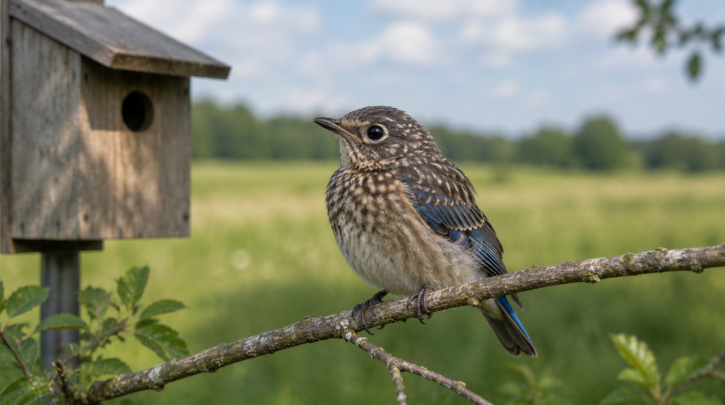

Bluebird chicks go from blind, featherless hatchlings to fully flighted fledglings in roughly three weeks — a fast, demanding developmental window that keeps both parents working hard from sunrise to dusk.
This site participates in affiliate programs. If you buy through a link on this page, we may earn a commission at no extra cost to you. Affiliate disclosure
At Hatching
Newly hatched bluebirds are altricial — blind, essentially featherless, and completely dependent on their parents for warmth and food from the moment they hatch. All eggs in a clutch typically hatch within about a day of each other, since the female generally doesn’t begin full incubation until the clutch is complete.
With a camera nest box like the Birdfy Nest Duo, you can watch hatching day from your phone instead of opening the box at the most sensitive stage.
The First Week
Parents brood the chicks — sitting on them to provide warmth — heavily during the first several days, since hatchlings can’t regulate their own body temperature yet. Feeding visits are frequent, with both parents delivering soft-bodied insects like caterpillars, which are easy for tiny chicks to swallow.
Growth Through the Second Week
Feathers begin emerging noticeably by the second week, and chicks become progressively more active inside the box, eventually able to raise their heads and beg vigorously whenever a parent arrives with food. Feeding frequency increases as the brood’s combined food demand grows along with their body size.
Fledging
- Typical age at fledging: 17 to 21 days after hatching
- Fledglings leave the nest with feathers grown in but flight skills still developing
- Newly fledged bluebirds show the same heavily spotted breast pattern seen across young thrushes, quite different from the clean plumage of adults
Fledging itself often happens within a fairly short window on a single day, with young birds leaving the box one after another rather than spread out over multiple days.
After Fledging: Still Dependent
Fledglings aren’t self-sufficient the moment they leave the box. Parents continue feeding them for roughly two to three weeks after fledging while flight and foraging skills develop. It’s common for the male to take over most or all of the feeding duties for a first brood if the female has already begun building a new nest for a second clutch.
If You Find a Fledgling on the Ground
A young bluebird found sitting on the ground, hopping and unable to fly well, is often not abandoned — this is a completely normal stage between leaving the box and becoming a strong flier, and a parent is usually nearby watching and still feeding it. The old idea that touching a baby bird causes parents to reject it due to human scent is a myth; birds have a limited sense of smell and won’t abandon a chick because a person handled it briefly.
When to Actually Intervene
- The bird is clearly injured, bleeding, or has an obviously broken wing
- It’s in immediate danger from a cat, dog, or busy road with no way to move itself to safety
- No parent has been seen checking on it for several hours in an area you can reliably watch
In most other cases, the right move is to leave a grounded fledgling alone or, if it’s in immediate danger, gently move it a short distance to nearby cover rather than removing it from the area entirely. A local wildlife rehabilitator is the right resource for any bird that appears genuinely injured or truly orphaned.
Want to give the next brood a better start? Revisit our nest box guide to make sure the box is cleaned out and ready before a second clutch begins.
How Parents Divide Feeding Duties
Both parents feed nestlings throughout the roughly three weeks between hatching and fledging, though the exact division of labor can shift depending on circumstances. If the female begins building a second nest before the first brood has fully fledged, the male often picks up a larger share of feeding duties for the older chicks, allowing the pair to overlap two nesting attempts in the same season rather than waiting for one to fully finish before starting the next.
Tracking Feeding Visits Without Disturbing the Nest
Watching feeding visits from a distance is one of the best ways to monitor an active nest without opening the box. A steady stream of visits every few minutes, with parents arriving and leaving quickly, is a strong sign of healthy chicks; a sudden, sustained drop in visit frequency can indicate a problem worth a closer, careful check.
Second and Third Broods
Once a first brood fledges and becomes independent, a pair frequently attempts a second nest in the same box or a nearby one, following the same hatching-to-fledging timeline. In the warmer southern portion of the Eastern Bluebird’s range, a third brood in a single season is possible, though less common than a second.