

For resident bluebird populations, winter is a season of fruit, flocks, and conserving energy — a very different rhythm from the territorial, insect-hunting pace of spring and summer.
Who Stays and Who Leaves
Winter bluebird presence depends heavily on species and region. Southern and central Eastern Bluebird populations, and many coastal or lower-elevation Western Bluebird populations, remain resident through winter. Mountain Bluebirds, by contrast, largely vacate their northern breeding range for wintering grounds across the Southwest. See our migration guide for the full species breakdown.
Winter Diet: Fruit Carries the Season
With insects largely unavailable, resident bluebirds lean almost entirely on fruit and berries through winter — sumac, holly, dogwood, cedar berries, viburnum, and in parts of the West, mistletoe. This dietary flexibility is exactly what allows year-round residency to work in the first place; see our diet guide for more detail on this seasonal shift.
Flocking for Warmth and Foraging
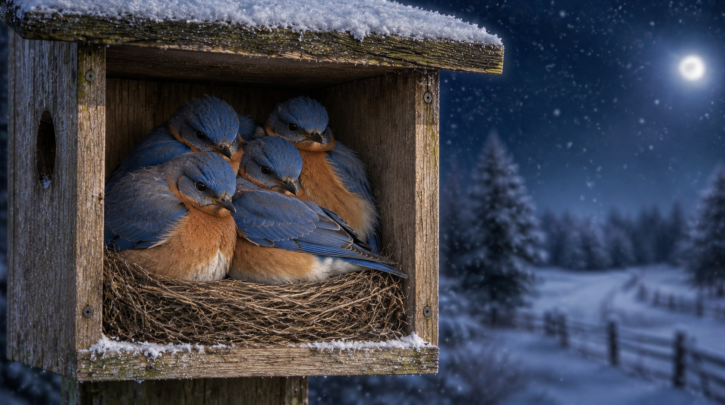
Winter bluebirds are typically found in loose flocks rather than as isolated pairs, often roosting communally overnight for warmth. It’s not unusual for several bluebirds to pack into a single nest box on an especially cold night, using it as a temporary roost site rather than an active nest — a behavior distinct from anything seen during the breeding season.
Cold Snaps and Ice Storms
Severe winter weather, particularly ice storms that coat fruiting shrubs and trees, can cut off food access for days at a time and represents one of the more serious threats resident bluebirds face. Prolonged cold combined with limited food access is a documented cause of winter mortality in bad years, which is part of why supplemental feeding matters most during exactly these stretches.
How to Help in Winter
- Keep a mealworm or suet feeder stocked through cold snaps, when natural food is hardest to reach
- Provide a reliable water source, since natural water can freeze over for extended periods
- Leave nest boxes up through winter rather than removing them — they double as roost sites
- Maintain native fruiting shrubs on the property as a long-term winter food source
Late Winter: The Turn Toward Spring
As winter progresses toward its end, flock behavior begins to break down, and scouting activity for the coming breeding season starts to pick up, sometimes well before the calendar suggests spring has arrived. See our spring guide for what comes next as territorial pairing resumes.
Want next season to go smoothly? Now is a good time to check that boxes are still sound and predator baffles are secure — see our nest box guide for a full pre-season checklist.
A Full Circle
From late-winter scouting through spring pairing, summer’s demanding broods, fall’s migration and molt, and back to a quiet winter flock, the bluebird year is a tightly connected cycle — and understanding each season’s demands is what makes it possible to actually help these birds through all of them, not just during the parts of the year that are easiest to watch.
Identifying Winter Bluebirds
Winter plumage looks essentially the same as breeding plumage in all three species, so the identification approach covered in our species identification guide applies just as well in January as it does in May. What changes is context: a winter sighting is far more likely to involve a loose flock than a solitary territorial pair, and birds are more likely to be found actively feeding on fruit than perched and scanning open ground for insects, which is itself a useful behavioral clue when a distant or backlit bird is hard to color-identify at a glance.
Feeder Activity in Winter
A mealworm or suet feeder that saw only occasional visits during the insect-rich summer months can become considerably more popular in winter, when natural food is harder to come by. Checking and refilling a winter feeder regularly, particularly right before and after a cold snap, supports resident birds exactly when supplemental food matters most, and a flock that discovers a reliable winter feeder often continues returning to the same spot well into the following spring.
Winter Roosting in Nest Boxes
Beyond their role as summer nest sites, boxes left up through winter provide genuine shelter value as communal night roosts during cold weather, which is one more reason to resist the temptation to take boxes down at the end of the breeding season. A box that shelters several bluebirds through a hard freeze is doing real work even outside the nesting months it’s most often associated with, and the same box will simply switch back to nesting duty once spring scouting activity resumes.